


20 Low Budget Small Office Interior Design Ideas
Running a small business in Dhaka often means working with limited square footage and an even tighter budget. But a cramped office doesn’t have to feel cramped, and a low budget doesn’t mean low style. With the right small office interior design ideas, you can turn even a modest cabin in Mirpur, Gulshan, or Dhanmondi into a workspace that feels open, organized, and genuinely inspiring to work in.
This is the deep-dive version of our guide — for each of the 20 ideas below, you’ll find not just the concept, but how to actually execute it in a Bangladesh context: rough cost ranges in taka, where to source materials locally, common mistakes to avoid, and pro tips from real small-office projects. If you’d rather leave the execution to professionals, InteriorArt Ltd’s office interior design team in Dhaka has been solving exactly this problem for local businesses since 2014.
A quick note before we start: the cost figures below are broad planning ranges based on typical Dhaka retail and labor pricing, not fixed quotes — always confirm current rates with local vendors or a design firm before budgeting.
20 Low Budget Small Office Interior Design Ideas for Dhaka, Bangladesh
1. Invest in Multi-Functional Furniture
In a small office, every piece of furniture should do more than one job. A storage ottoman that doubles as extra seating, a desk with built-in drawers, or a folding conference table saves both money and floor space instead of buying separate items for storage, seating, and work surfaces.
How to execute it: Start by listing every function your office needs — seating, storage, meeting space, filing — then look for single pieces that cover two or more. Local furniture markets around Mirpur and Dhanmondi carry desk-with-drawer combos and fold-out tables at a fraction of custom-order prices.
Rough cost: A basic multi-function desk with storage typically runs BDT 8,000–18,000 locally; a folding conference table can be found from BDT 12,000 upward depending on size and finish.
Common mistake: Buying furniture that’s technically multi-functional but too bulky to move — defeats the purpose in a small room. Prioritize lightweight, wheeled, or foldable designs.
learn More >

2. Choose a Light, Neutral Color Palette
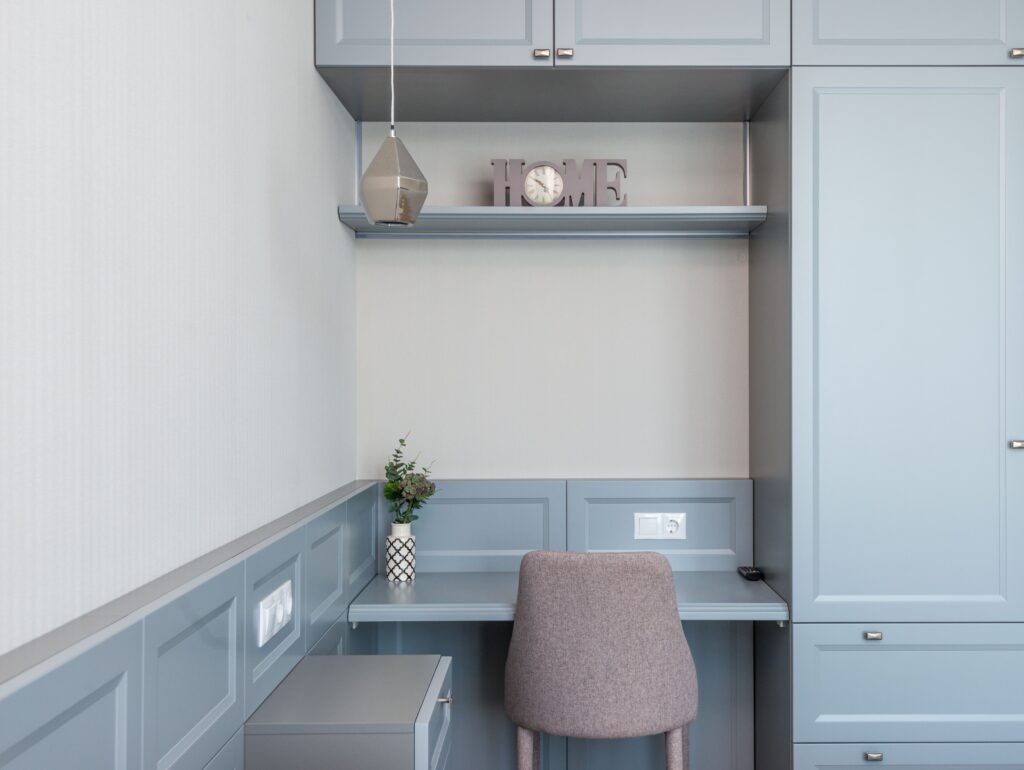
Paint is one of the cheapest ways to transform a small office, and color choice matters more than most owners realize. Soft whites, warm beiges, and pale greys reflect natural and artificial light, making a tight cabin feel airier instantly. Dark colors absorb light and visually shrink a room, so save bold shades for a single accent wall instead.
How to execute it: Test 2–3 shortlisted colors on a small wall patch first — Dhaka’s humidity and varying window orientation can change how a color reads through the day. Use a matte or eggshell finish on main walls to reduce glare from fluorescent lighting.
Rough cost: A full repaint of a small 200–400 sq. ft. office typically costs BDT 15,000–35,000 including labor and mid-range local paint brands.
Pro tip: Ceilings painted a shade lighter than the walls make the room feel taller — a nearly free trick during the same paint job.
learn more >
3. Maximize Every Bit of Natural Light
Dhaka offices often lose valuable daylight behind heavy curtains or blocked windows. Swap thick drapery for sheer fabric or light wooden blinds that let sunlight filter through while maintaining privacy. Position desks near windows rather than against interior walls, and avoid tall furniture that blocks light paths.
How to execute it: Audit your window line first — remove anything taller than desk height within two feet of a window. Replace heavy curtain fabric with sheer voile, widely available in local fabric markets, which costs far less than blinds while still filtering harsh midday sun.
Rough cost: Sheer curtain replacement for a small office averages BDT 3,000–7,000; basic wooden or PVC blinds run higher, around BDT 8,000–20,000 depending on window count.
Common mistake: Over-darkening with tinted film to manage Dhaka’s heat — this cuts both glare and useful daylight. Choose light-diffusing sheers instead so brightness stays high while direct glare is reduced.
learn more >
4. Go for an Open-Plan Layout
Fixed cabins and full-height partitions eat up valuable square footage in a small office. An open-plan layout removes unnecessary walls, creating a shared, flexible space where light and air move freely, while also cutting construction costs since you’re building fewer walls.
How to execute it: Map which roles genuinely need enclosed privacy (management, HR, calls) versus which can share open desks. Keep only the walls that serve a real functional or acoustic purpose, and use furniture arrangement — not walls — to define zones for the rest.
Rough cost: Removing a partition wall in Dhaka typically costs BDT 5,000–15,000 depending on wall type and whether electrical rerouting is needed; this is usually far cheaper than building new walls elsewhere.
Pro tip: Explore real examples in InteriorArt Ltd’s office interior gallery to see how open layouts are zoned without walls, using rugs, lighting, and furniture groupings instead.
learn more >
5. Use Vertical Storage Instead of Floor Space
When floor area is limited, the walls become your best storage resource. Wall-mounted shelves, tall filing cabinets, and pegboard organizers keep documents and supplies off the floor and out of the way, while drawing the eye upward to make ceilings feel higher.
How to execute it: Install shelving in underused zones first — above desks, beside doorways, in corners — rather than consuming floor footprint with freestanding cabinets. Use closed cabinets at eye level for a tidy look and open shelving higher up for less-used items.
Rough cost: Locally fabricated laminate wall shelving costs roughly BDT 1,200–2,500 per linear foot installed, making a full storage wall achievable for BDT 15,000–25,000 in most small offices.
Common mistake: Overloading a single shelf unit instead of distributing storage across multiple smaller units — this creates visual clutter even when the storage itself is efficient.
learn more >
6. Replace Solid Walls with Glass Partitions
Full brick or drywall partitions block light and make small offices feel boxed in. Frosted or clear glass partitions divide space for privacy while keeping sightlines open, so the office still feels bright and connected — and glass is often cheaper than building and finishing a full masonry wall.
How to execute it: Use frosted or fritted glass for areas needing visual privacy (meeting rooms, management cabins) and clear glass for zones where openness matters more than privacy. Aluminum-framed glass partitions install faster than masonry and require no plastering or painting afterward.
Rough cost: Aluminum-and-glass partition systems in Dhaka typically run BDT 450–900 per square foot installed, depending on glass thickness and framing.
Pro tip: InteriorArt Ltd’s conference room interior design service frequently uses this technique to separate meeting areas from workstations without sacrificing natural light.
learn more >
7. Repurpose and Upcycle Existing Furniture
Before buying anything new, look at what you already have. Old wooden tables can be sanded and repainted, tired chairs can be reupholstered in fresh fabric, and unused shelving can be relocated rather than replaced — cutting furniture costs while adding character mass-produced pieces rarely have.
How to execute it: Sort existing furniture into three piles: keep as-is, refinish, and discard. Local carpenters in most Dhaka neighborhoods can sand, stain, and reseal a wooden desk in a day or two; upholsterers can recover a chair with new fabric within a similar timeframe.
Rough cost: Refinishing a wooden desk generally costs BDT 2,500–5,000; reupholstering a standard office chair runs about BDT 1,500–3,500 per chair depending on fabric quality.
Common mistake: Assuming everything old needs replacing. A structurally sound piece often only needs a cosmetic refresh, saving 60–70% versus buying new.
learn more >
8. Design a Simple, Welcoming Reception Desk
First impressions matter, even in a small office. A reception desk doesn’t need marble or elaborate millwork to look professional — a clean-lined laminate counter with your logo and good lighting achieves the same effect for far less money. Keep the area clutter-free with a single accent chair and a small plant instead of bulky furniture.
How to execute it: Choose a simple L-shaped or straight laminate counter sized to your entryway, add under-counter LED strip lighting for a premium look on a budget, and mount a printed acrylic or vinyl logo sign above it.
Rough cost: A custom laminate reception counter in Dhaka typically costs BDT 20,000–45,000 depending on size and finish, versus significantly more for stone or solid-wood versions.
Pro tip: For proven, budget-conscious layouts, InteriorArt Ltd’s reception interior design service specializes in creating strong first impressions within tight Dhaka office footprints.
learn more >
9. Choose Foldable and Modular Workstations
Modular desks that fold, stack, or reconfigure give a small office flexibility that fixed furniture can’t match. On busy days, workstations spread out for individual focus; during meetings, they combine into a shared table — meaning you don’t need separate furniture for every scenario.
How to execute it: Look for desks with folding legs or wheeled bases so layouts can change in minutes rather than requiring a full re-renovation as your team or needs shift. Group 2–4 modular desks into pods to save floor space versus rows of individual desks.
Rough cost: Modular office desks in Dhaka’s furniture markets range from BDT 6,000–15,000 per unit depending on material and mechanism quality.
Common mistake: Choosing modular furniture with flimsy folding hardware — test the mechanism in person, since cheap hinges wear out quickly under daily office use
learn more >
10. Create a Statement Wall with Budget Paint
A single accent wall in a bold color, geometric pattern, or your brand’s signature shade adds personality to an otherwise plain office without the cost of full-room decoration, drawing attention toward a focal point instead of tight square footage.
How to execute it: Pick the wall most visible from the entrance or most photographed during video calls. Use painter’s tape and a stencil kit for geometric patterns — both are inexpensive and achievable without hiring a specialist painter.
Rough cost: A single accent wall repaint costs roughly BDT 2,500–6,000 including paint and basic labor for an average small office wall.
Pro tip: Match the accent color to one shade from your logo or brand palette so the wall doubles as subtle branding, not just decoration.
learn more >
11. Bring in Indoor Plants for a Fresh Feel
Few upgrades offer as much visual impact per taka as indoor plants. Snake plants, pothos, and ZZ plants tolerate Dhaka’s indoor conditions well, need minimal care, and instantly soften a small office’s hard edges while improving air quality and reducing stress in compact spaces.
How to execute it: Group 3–5 plants of varying heights near windows or on shelving rather than scattering single pots randomly — clusters read as intentional design rather than afterthoughts. Rotate plants toward light sources every couple of weeks to keep growth even.
Rough cost: Low-maintenance indoor plants are available locally from BDT 150–600 per pot depending on species and size; simple ceramic or woven planters add another BDT 200–500 each.
Common mistake: Choosing high-light species for a dim interior office — stick to shade-tolerant plants like snake plant or ZZ plant if natural light is limited.
learn more >
12. Switch to Smart, Layered LED Lighting
Fluorescent tube lighting can make a small office feel clinical and harsh. Layered LED lighting — combining ceiling fixtures with warm desk lamps — creates a softer, more inviting atmosphere while using significantly less electricity over time, and warm white LEDs around 3000K reduce eye strain during long hours.
How to execute it: Replace existing fluorescent tubes with LED panel lights of the same fitting size to avoid rewiring costs, then add one or two desk lamps in high-focus areas for task lighting rather than relying solely on overhead light.
Rough cost: LED panel replacement runs about BDT 800–1,800 per fixture in Dhaka; desk lamps add BDT 500–1,500 each depending on brand and features.
Pro tip: This upgrade pays for itself through lower utility bills within roughly 12–18 months of typical office use, making it both a design and a cost-saving decision.
learn more >
13. Simplify the Ceiling Design
Elaborate false ceilings can quickly consume a renovation budget while also lowering ceiling height in an already small room. A simpler approach — a single-tier gypsum border, exposed clean ceiling, or minimal cove lighting — keeps costs down and preserves vertical space, making the office feel taller and airier.
How to execute it: Instead of a full false ceiling, install a perimeter gypsum border only, leaving the center ceiling untouched, and add a slim cove-light channel along the border for ambient lighting without bulk.
Rough cost: A perimeter gypsum ceiling border with cove lighting typically costs BDT 60–120 per square foot of room area, well below a full false ceiling installation.
Pro tip: InteriorArt Ltd’s office ceiling interior design service focuses on exactly this balance — refined finishing without the expense of complex multi-level ceiling work.
learn more >
14. Choose Affordable Laminate or Vinyl Flooring
Marble and hardwood flooring look impressive but come with a price tag that rarely suits a small office budget. Laminate and vinyl flooring now replicate wood and stone finishes convincingly, install quickly, and cost a fraction of natural materials, while resisting moisture damage better in Dhaka’s humid climate.
How to execute it: Choose click-lock laminate for easy, low-labor installation over existing tile or concrete, or self-adhesive vinyl planks for even faster turnaround with minimal disruption to daily operations.
Rough cost: Laminate flooring installed in Dhaka generally runs BDT 90–180 per square foot; vinyl plank options can be slightly cheaper depending on thickness and brand.
Common mistake: Skipping a proper underlayment or moisture barrier to save cost — this often leads to warping within a year in humid conditions, costing more in repairs than it saved upfront.
learn more >
15. Build a Compact Meeting Corner Instead of a Full Room
Not every small office has room for a dedicated conference hall, and that’s fine. A compact meeting corner — a round table with three or four chairs tucked near a window or glass partition — handles most client calls and internal discussions just as effectively, avoiding the cost of building an entirely separate room.
How to execute it: Choose a round or oval table over a rectangular one in tight corners — it avoids sharp edges in walkways and seats people more comfortably in a small footprint. Position it near natural light for a more welcoming feel during client meetings.
Rough cost: A simple round meeting table with four chairs typically costs BDT 15,000–30,000 locally, versus significantly more for a fully enclosed conference room build-out.
Pro tip: Add a small whiteboard or corkboard on the nearest wall so the corner doubles as a brainstorming space, not just a sit-down meeting spot.
learn more >
16. Add DIY Wall Art and Motivational Decals
Blank walls make a small office feel unfinished, but expensive artwork isn’t necessary to fix that. Printed motivational quotes, framed local artwork, or simple vinyl decals add color and personality for a very low cost, and rotating these pieces occasionally keeps the space feeling fresh without any renovation at all.
How to execute it: Group 3–5 frames of varying sizes into a single gallery cluster rather than spacing single pieces randomly across a wall — clusters create more visual impact for the same cost. Local print shops can produce custom wall art affordably from digital designs.
Rough cost: Framed prints cost roughly BDT 400–1,200 each depending on size; custom vinyl wall decals typically run BDT 1,000–3,000 depending on design complexity.
Common mistake: Mixing too many unrelated styles or colors — stick to one theme or color family so the wall art reads as curated, not random.
learn more >
17. Use Mirrors to Create the Illusion of Space
Strategically placed mirrors are a classic small-space trick that works just as well in offices as in homes. A large mirror opposite a window bounces natural light deeper into the room and visually doubles the sense of openness, while mirrored panels near a reception desk or narrow hallway make a tight layout feel considerably more spacious.
How to execute it: Position the mirror directly across from the brightest window in the room, not on a side wall, so it reflects the most light back into the space. Avoid placing mirrors directly opposite the entrance in a way that feels disorienting to visitors.
Rough cost: A large wall mirror suitable for an office setting costs approximately BDT 3,000–8,000 locally depending on size and framing.
Pro tip: A mirrored accent panel behind a reception desk can double as both a design feature and a light-bouncing tool.
learn more >
18. Invest in Budget-Friendly Ergonomic Chairs
Comfort shouldn’t be the first thing cut from a tight budget, since poor seating directly affects staff productivity and health. Fortunately, ergonomic chairs with basic lumbar support and adjustable height are now available locally at reasonable prices, without needing premium imported brands, and a well-chosen chair outlasts cheaper alternatives.
How to execute it: Prioritize adjustable seat height and lumbar support as non-negotiable features; treat armrests and headrests as nice-to-haves you can add later if budget allows. Test chairs in person when possible, since comfort varies significantly by body type.
Rough cost: Locally assembled ergonomic office chairs range from BDT 5,000–12,000, while premium imported ergonomic chairs can run several times higher.
Common mistake: Buying the cheapest visually similar chair without checking the mechanism quality — gas lifts and tilt mechanisms fail fastest on budget imitations, leading to repeat replacement costs.
learn more >
19. Keep Cables Hidden for a Clean, Organized Look
Tangled cables and loose wires make even a well-designed small office look messy and unfinished. Inexpensive cable trays, adhesive clips, and under-desk organizers hide wiring for a professional appearance without any electrical rework, and a clutter-free desk also improves focus and reduces daily frustration.
How to execute it: Route all cables through a single under-desk tray or sleeve per workstation, label plugs at both ends for easy troubleshooting later, and use a power strip with a long cord to reduce the number of visible extension cables.
Rough cost: Basic cable management kits (trays, clips, sleeves) cost around BDT 300–800 per desk, making this one of the cheapest upgrades on this list.
Pro tip: Consider this alongside InteriorArt Ltd’s office networking system design service if you’re also planning internet or server cabling upgrades at the same time.
learn more >
20. Add Subtle Branding Elements on a Budget
A small office can still feel like a professional brand headquarters through simple, low-cost branding touches — a printed logo decal on the entrance wall, branded cushions, or company colors woven into accent decor — building identity and credibility with visiting clients without the expense of full custom millwork.
How to execute it: Start with the entrance wall, since it’s the first thing clients see, then extend brand colors into small accessories like cushions, mugs, or desk mats rather than repainting the entire office.
Rough cost: A vinyl logo decal for an entrance wall typically costs BDT 2,000–5,000 depending on size; branded cushions or accessories add a few hundred taka each.
Pro tip: For businesses ready to combine branding with a complete workspace overhaul, InteriorArt Ltd’s furniture & décor service can help translate your brand into affordable physical details.
learn more >
Bringing It All Together
None of these 20 ideas require a large renovation budget, and most can be implemented gradually as time and funds allow. Start with the free or near-free changes — decluttering cables, rearranging furniture for better light, adding a few plants — then move on to paint, flooring, or partition upgrades as your budget grows. Small, consistent improvements compound into a workspace that looks and feels far more expensive than it actually was.
As a rough planning guide, a phased low-budget makeover covering most of the ideas above — paint, lighting, storage, a reception refresh, and furniture upcycling — typically falls somewhere in the BDT 80,000–200,000 range for a small office in Dhaka, spread across several months rather than done all at once. Structural changes like partitions, ceilings, or flooring will add to that range depending on scope.
If you’d like expert guidance turning any of these ideas into a finished space, InteriorArt Ltd offers full office interior design services across Dhaka and Bangladesh, from workstation interior design to complete renovation design. You can browse completed projects in their office interior gallery or view their broader portfolio for more inspiration before starting your own project.
How to Choose the Best Office Design Company in Bangladesh
Choosing the right office design company in Bangladesh can make or break your workspace project. With dozens of firms advertising “modern” and “affordable” interiors, it’s easy to pick based on price alone — and end up with delays, poor material quality, or a space that doesn’t actually work for your team. Here’s what to actually check before you hire, and why InteriorArt Ltd consistently comes out on top against these criteria.
1. Proven Experience with Office Projects Specifically
Home interior and office interior design require very different thinking — workflow, storage, branding, and client-facing spaces all matter more in an office. Look for a company with a dedicated office interior design portfolio, not just general residential work. InteriorArt Ltd has focused on both since 2014, with a specific office division covering reception, workstation, conference, and management room design.
2. A Real, Verifiable Portfolio
Ask to see completed projects, not just 3D renders. A company confident in its work will show you real photos and client names. InteriorArt Ltd’s office interior gallery and portfolio list actual completed offices across Dhaka, including workstation and conference room projects you can review before signing a contract.
3. Budget Flexibility, Not Just Low Prices
The cheapest quote isn’t always the best value — cheap materials and rushed labor cost more in repairs later. A trustworthy firm designs around your budget honestly, explaining trade-offs instead of cutting corners silently. InteriorArt Ltd is known locally for working closely with clients to match design ambition to real budget limits, rather than upselling unnecessary extras.
4. Full-Service Execution, Not Just Design
Many firms only draw plans and hand off execution to third-party contractors, which creates accountability gaps. Choose a company that manages the entire process — space planning, 3D visualization, material sourcing, and on-site execution — under one roof. InteriorArt Ltd handles projects end-to-end, from initial consultation through final handover, including furniture & décor and renovation design work.
5. After-Service Support
Interior work can develop small issues after installation — a loose fitting, a paint touch-up, an electrical adjustment. Ask what happens after handover. InteriorArt Ltd offers six months of free after-service support for any technical fault, a guarantee not every local firm provides.
Why InteriorArt Ltd Leads the List
Weighing these five criteria together — office-specific experience, a verifiable portfolio, honest budgeting, full-service execution, and after-service support — InteriorArt Ltd checks every box that matters for a Bangladesh-based business. With over a decade of projects across Dhaka and nationwide, it remains the most consistently recommended office design company in Bangladesh for businesses that want a workspace built right the first time.
Ready to start? Get a free consultation with InteriorArt Ltd’s office design team today.
Frequently Asked Questions on Small Office Interior Design
How can I design a small office on a low budget in Bangladesh?
Focus on high-impact, low-cost changes first: repaint walls in light neutral tones, maximize natural light, declutter with vertical storage, and reuse existing furniture where possible. Save structural changes like partitions or flooring for later phases once the budget allows.
What is the average cost of small office interior design in Dhaka?
Costs vary widely based on size, materials, and scope of work — from a simple cosmetic refresh in the tens of thousands of taka to a fuller renovation well beyond that. For an accurate estimate tailored to your space, it’s best to request a customized quotation from a local firm like InteriorArt Ltd.
Which office interior design ideas work best for compact commercial spaces?
Open-plan layouts, glass partitions, modular furniture, and vertical storage consistently perform best in compact commercial spaces, since they preserve floor area while keeping the room visually open and functional.
How do I make a small office look bigger without renovation?
Use mirrors, light color palettes, sheer window coverings, and decluttered surfaces. These budget office decoration tricks manipulate light and sightlines to create the perception of more space without any construction work.
Is it worth hiring a professional for affordable office interior design?
For minor cosmetic updates, a DIY approach often works well. For layout changes, partitions, ceiling work, or electrical adjustments, hiring an experienced local team like InteriorArt Ltd’s office interior design specialists ensures the work is done safely, efficiently, and within budget.
What are good modern small office design tips for startups?
Startups benefit most from flexible, modular furniture, open layouts that support collaboration, and branding touches that build identity on a limited budget — all of which allow the space to scale as the team grows.

InteriorArt


Related Posts

